
I often find myself in the important position of helping parents become savvy consumers of instructors for their children who have Dyslexia. What’s the difference between the teacher who tutors after school and a Dyslexia Therapist? Individuals with Dyslexia require an instructor with highly specialized knowledge and experience of WHAT and HOW to teach Structured Literacy.
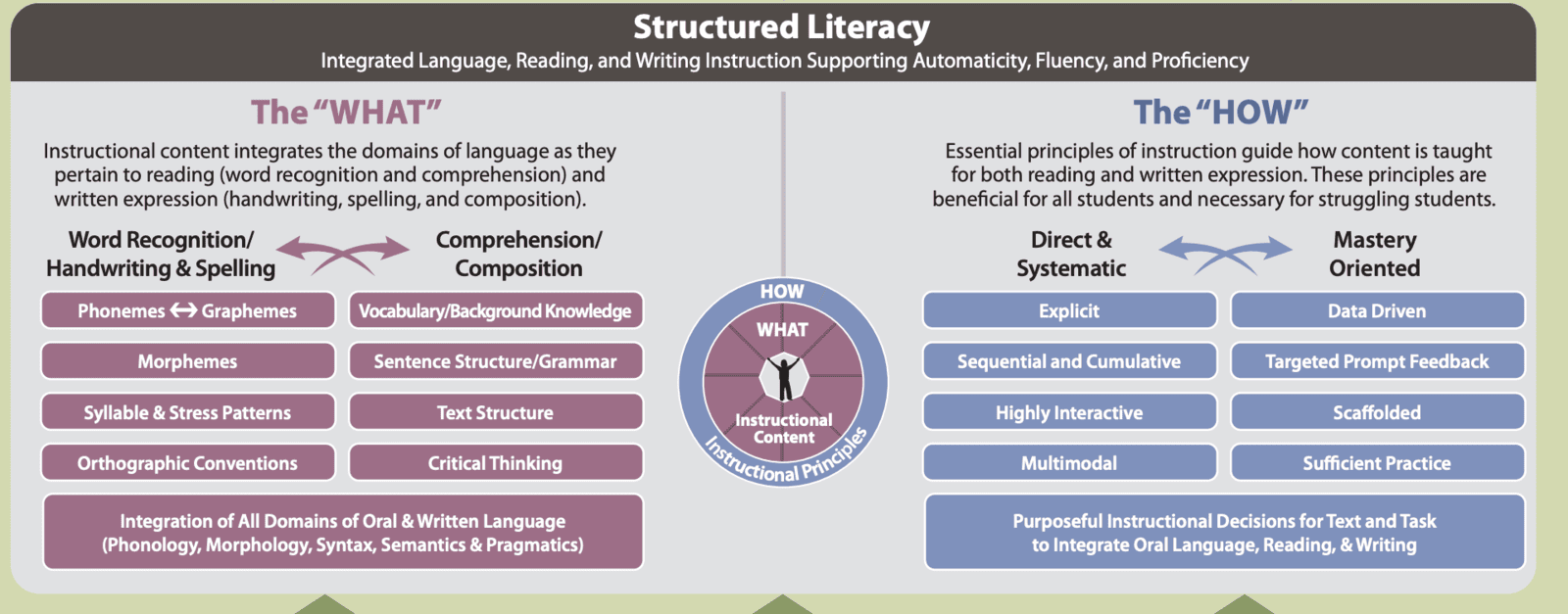
Below is a new infographic developed by the International Dyslexia Association that explains what Structured Literacy encompasses. Dyslexic students require instruction in every component of Structured Literacy. It’s not just phonics focused, nor is the instruction workbook or computer heavy. Carefully crafted lesson plans that address all areas of Structured Literacy are developed and delivered in a multimodal manner, preferably in-person.
Another section of IDA's new infographic explains WHO should be providing the instruction and WHEN. For example, all general education teachers should have basic knowledge of Structured Literacy. Educators working with struggling general education students identified through universal screening require a deeper set of knowledge and experience in order to meaningfully address the needs of struggling readers. Finally, those students that have not made progress within their school's Tier 2 program of support not only require greater intensity and frequency of an intervention, they require an expert instructor who holds the necessary credentials.

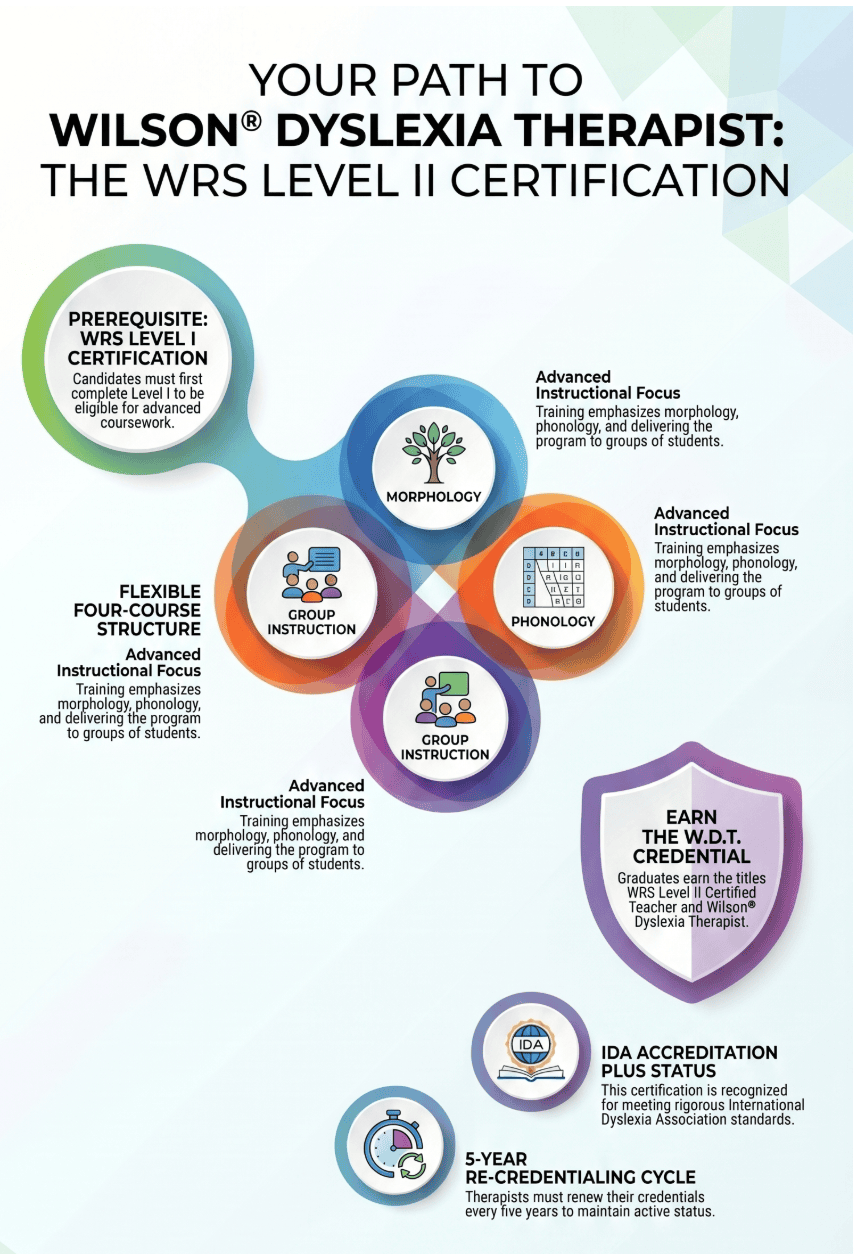
Another important infographic, pictured below, was created by me to help explain to parents the intensive program that individuals like myself complete in order to become a certified Dyslexia Therapist through Wilson Language, accredited by the International Dyslexia Association (IDA). The Wilson Reading System is an intensive intervention grounded in Structured Literacy (sometimes used interchangeably with the term, Orton-Gillingham). The successful completion of three supervised practicums and graduate coursework were required to earn this esteemed credential. The credential, by the way, must be renewed by submitting proof of ongoing professional learning in the field of Structured Literacy. Our field of Dyslexia and its associated learning disabilities is dynamic - there is always a new study or resource to learn about. A Dyslexia Therapist who maintains their credentials is on top of the latest research which has implications for our clients.
When interviewing a potential instructor, I tell parents that they should ask the individual WHERE they received their training from and whether they completed at least one supervised graduate level practicum. In addition to Wilson Language that prepares Dyslexia Therapists, Fairleigh Dickinson University in New Jersey offers the therapist level certification. If you have a dyslexic child who has mastered early phonetic patterns and now needs that same multimodal explicit instruction for advanced phonics, morphology, and developing fluency with academic text, you need to ask if the potential instructor has completed advanced coursework to learn what and how to teach advanced English orthographic patterns.
Not every program that trains educators in Structured Literacy offers advanced coursework that so many of our middle and high school students require to succeed. As I have observed in several late elementary and middle school supplemental reading lessons this year, dyslexic students have a steady diet of decodable stories with little to no work on developing academic vocabulary and reading comprehension with authentic academic texts.
As an LDT-C (educational diagnostician) and Dyslexia Therapist, I have been trained on how to conduct thorough assessments and progress monitor to ensure that my lessons are tailored to the very specific needs of my clients - technically it is called "diagnostic instruction." A Dyslexia Therapist doesn't teach from scripted program, that is where the art of "diagnostic" teaching comes into play. I have evaluated too many students who get "stuck" on a 2nd/3rd grade level because their intervention teacher does not have the advanced knowledge to know how to advance their own skills and tackle academic reading and writing. They also don't have the diagnostic expertise to identify what skills require instruction versus skills that have been mastered.
Unfortunately, due to time constraints, the Structured Literacy lesson plan that the school-based intervention teacher may have been trained to use is not fully implemented. This is one of the most carefully kept secrets among school administrators. Two 30 minute sessions a week with the school's intervention teacher yields, barely, one full intensive Structured Literacy lesson plan. Thus, the ongoing need for parents to seek outside specialized intervention to avoid the development of a greater gap with peers rather than closing it and attaining the dyslexic child's full potential.
My go-to resource for parents is the International Dyslexia Association's website that lists programs that offer supervised graduate level practicums. As a parent of a child with identified Dyslexia, you want someone who holds the highest level of credentials to help make a difference with your childl; someone who has graduated from one of the higher ed. or independent programs listed as being Accreditation Plus on the International Dyslexia Association's website. Here is the link for your reference: https://dyslexiaida.org/accredited-teaching-training-programs/
To learn more about how a Dyslexia Therapist can make a difference, contact susan@write2readsolutions.com